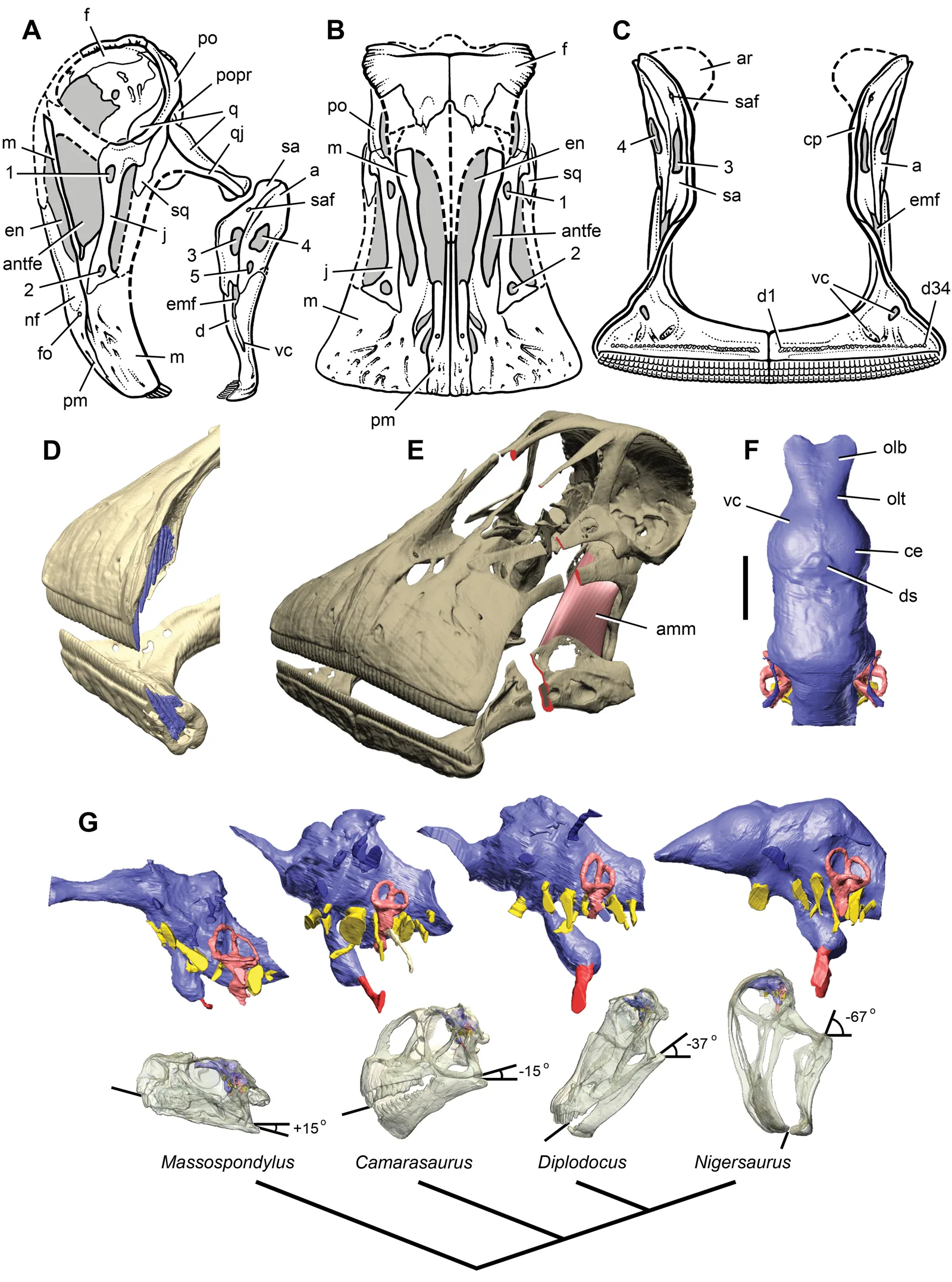
جزازة عشب برقبة طويلة
Nigersaurus
آكل نبات كان يقصّ الأرض، لا قمم الأشجار.
Figure of the skull and head posture of Nigersaurus taqueti from Sereno and others, 2007. CC BY 2.5, via Wikimedia Commons. This is a scientific figure, not a photograph of a mounted skeleton. The original file is 3540 × 4766 pixels. This page serves that full size, plus 2560 and 1600 pixels wide, not enlarged. File page

TODO machine-draft translation: English for review.
Nigersaurus taqueti is a sauropod, a long-necked plant-eater, from the Elrhaz Formation at Gadoufaoua in Niger. It is a rebbachisaurid. The skull is built to crop plants at the ground, not to reach a high crown.
Timeline
- Sereno and Wilson (2005) place it in the Early Cretaceous, Aptian to Albian, of the Elrhaz Formation.
- Sereno and others (2007) reconstruct an adult about 9 m long, with a femur about 1 m long. That skeleton is several partial skeletons, scaled to one size. It is not one complete animal found in a single pose.
What we know
- The holotype, MNN GDF512, is a skull and neck found together on about 1 m² of sandstone. Limb bones found farther away are not securely the same individual. Sereno and Wilson, 2005
- The jaws hold tooth batteries at the front of the muzzle. One skull has more than 500 teeth if the replacement teeth are counted. A tooth could be replaced about once a month. The inner ear shows a habitual head posture with the muzzle aimed at the ground. Sereno and others, 2007
- The paper defines ground-level browsing as cropping plants within one meter of the soil. In the Aptian and Albian that ground cover was ferns, horsetails, and other plants that were not grass. Grass is a later arrival.
What we don’t know yet
- How many neck vertebrae a rebbachisaurid had. The 2007 paper says only eight neck vertebrae are known for the group in the comparison it discusses, and it still draws Nigersaurus with 13. The neck in the drawing is a reconstruction.
- Whether every diplodocoid fed this way. The authors call widespread ground-level browsing a hypothesis that needs more teeth to test.
- A body mass in kilograms. The paper says the mass was comparable to an elephant’s and does not print a number. This page does not invent one.
Its role in Earth’s ecosystem
In a fauna with several sauropods, Nigersaurus took the lowest slice. A muzzle that faces the ground, a tooth battery at the front, and wear on the outer face of the teeth are the 2007 paper’s evidence that it gathered soft plants within a meter of the soil. That lowers the feeding band of the whole fauna: other sauropods could reach higher, and this one cropped the mat. Sereno and others, 2007
Sereno and Wilson (2005) also note that Cretaceous sauropods stayed diverse on southern continents while ornithischians with tooth batteries rose in the north. Nigersaurus is their southern example of a sauropod that evolved its own tooth battery. It was not a predator, and these papers do not name an animal that ate it.
Sources (3)
- Sereno, Wilson, Witmer, Whitlock, Maga, Ide, and Rowe, 2007, PLoS ONE
- Sereno and Wilson, 2005, the tooth-battery chapter (PDF). The Gadoufaoua coordinate and the holotype limits are here.
- Wikimedia Commons — the hero figure, CC BY 2.5
Where the fossils are
Each icon is this dinosaur, drawn for this site. It sits on a fossil locality as that place is today.
These icons mark fossils on today’s map. When the animal lived, the continents were not in these places.