سنّور، لا نمر
القط ذو الأسنان السيفية
سميلودون سنّور. ليس نمراً.
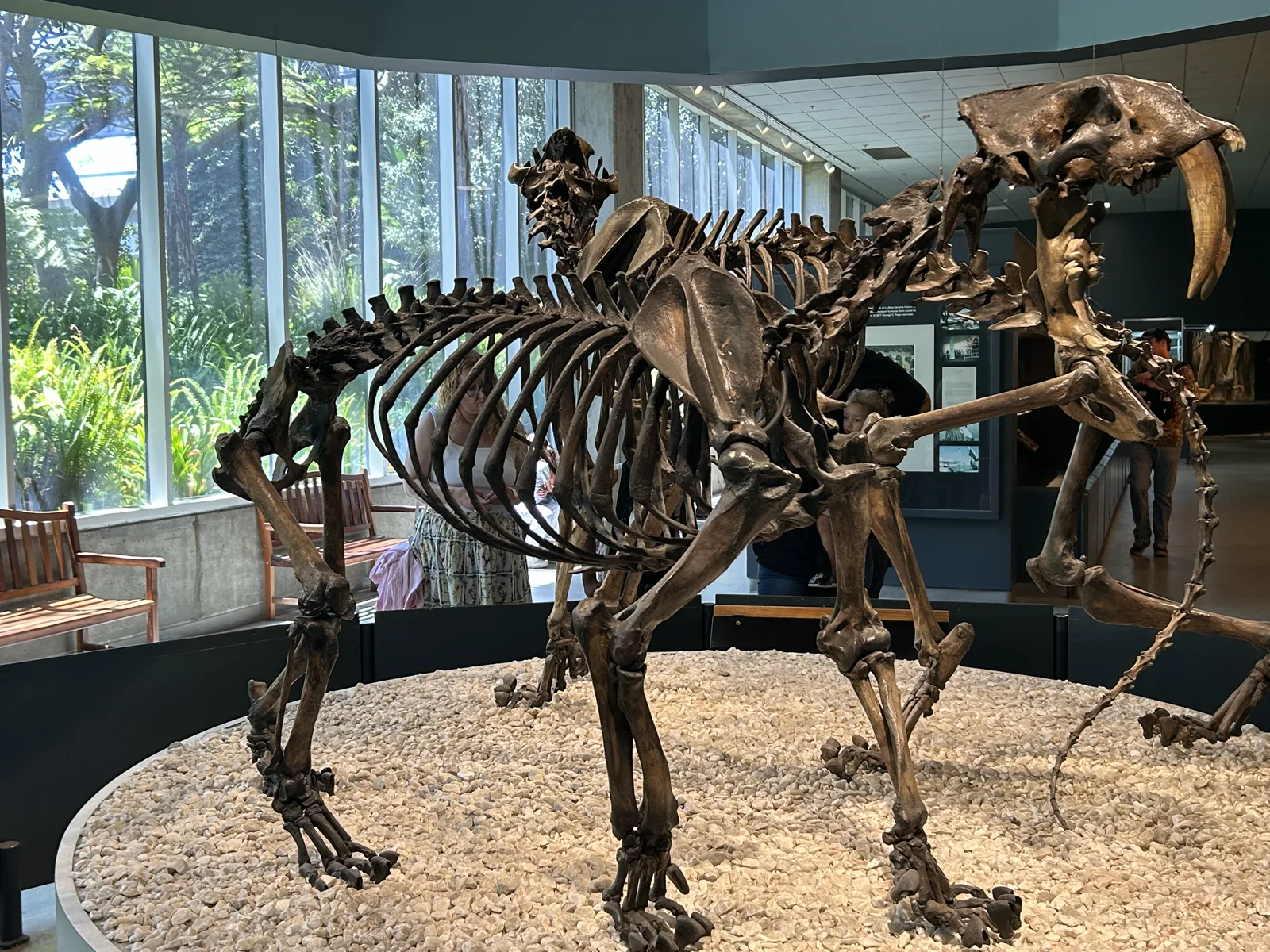
Skeleton of Smilodon fatalis at the La Brea Tar Pits Museum, as the file page describes it. TheUltimateGrass, CC0, via Wikimedia Commons. The original photograph is 4032 × 3024 pixels. This page serves it at 4032, 2560, and 1600 pixels wide, not enlarged. File page

TODO machine-draft translation: English for review.
Smilodon is in the cat family, Felidae. The saber-toothed cats, Machairodontinae, are an extinct branch of that family. Tigers are a different branch: the living cat Panthera tigris. The nickname “saber-toothed tiger” is easy to say, and it is the wrong animal. The La Brea Tar Pits museum explains why the nickname stuck, and why the museum does not use it. La Brea Tar Pits — Smilodon, saber-tooths, and tigers
Three species, one timeline
A 2025 tooth-wear study by Pardo-Judd and DeSantis treats three species as the current set, and it repeats the age and size ranges used in earlier work. Pardo-Judd and DeSantis, 2025
- Smilodon gracilis, the earliest and the smallest: about 2.5 million to 500,000 years ago, and about 55–100 kg, near the size of a jaguar. In Florida, the same study used teeth from Leisey Shell Pit 1A and Inglis 1A.
- Smilodon fatalis: about 1.6 million to 10,000 years ago, and about 160–280 kg. This is the cat at La Brea, and the cat at the Talara tar seeps in Peru.
- Smilodon populator: about 1 million to 10,000 years ago, the largest, and it could pass 400 kg. It lived in South America east of the Andes. Peter Lund named it from caves at Lagoa Santa, Brazil.
Kurtén and Werdelin (1990) separate the large eastern South American form, S. populator, from the North American S. fatalis. They place the west coast of South America, Peru and Ecuador, with S. fatalis. Kurtén and Werdelin, 1990
What we know
- Asphalt at La Brea trapped Ice Age animals and preserved their bones. The Florida Museum of Natural History says more than 2,000 skulls of S. fatalis come from those pits. Florida Museum species page La Brea Tar Pits & Museum
- The 2025 paper describes S. fatalis as an ambush hunter: heavy shoulders to hold prey larger than itself, and a bite weaker than the bite of cats that did not have saber teeth. That sentence is the paper’s summary of earlier studies, which it cites.
- In that same study, tooth wear from Florida and tooth wear from La Brea were not distinguishable. The Florida cats and the La Brea cats seem to have used carcasses in a similar way.
- At Talara, Peru, tar seeps trapped animals too. Seymour (2010) counted a minimum of 20 S. fatalis in a collection of more than 27,000 bones at the Royal Ontario Museum. Cruz, Lindsey, and others (2024) publish the map point used here and report dates of about 14,500 to 17,000 years before present for the Talara deposits. Seymour, 2010 Cruz, Lindsey, and others, 2024
- In the Pampas of Buenos Aires Province, Argentina, S. populator was present around the last glacial maximum. Bocherens and others, 2016
What we don’t know yet
- Whether the huge La Brea sample stands for the species everywhere. The 2025 paper says that is still open, because most fossil sites preserve far fewer carnivores.
- Whether these cats hunted in groups. The Florida Museum’s species page points to studies that do not agree. This page does not choose one of them.
- S. gracilis and S. populator are known from many fewer skeletons than La Brea’s S. fatalis. The 2025 study found the tooth wear of Florida gracilis and Florida fatalis indistinguishable. That went against the simple idea that the smaller species ate softer food.
- Fur color and spots are not preserved on these bones. The La Brea essay says early paintings often left the coat plain, and later paintings often added spots. A painting is not a photograph.
Sources (10)
- La Brea Tar Pits — Smilodon, saber-tooths, and tigers
- La Brea Tar Pits & Museum
- Florida Museum of Natural History — Smilodon fatalis. The page lists Florida sites, including Sabertooth Cave and the Ichetucknee River, and it says the Florida records of this species are Rancholabrean. It also says the old name Smilodon floridanus was given to a skull found in 1888 near Ocala, now on display at the Wagner Free Institute of Science in Philadelphia.
- Pardo-Judd and DeSantis, 2025, The Anatomical Record. Dental wear of S. gracilis and S. fatalis in Florida, compared with La Brea.
- Kurtén and Werdelin, 1990, Journal of Vertebrate Paleontology
- Seymour, 2010, Talara and Corralito
- Cruz, Lindsey, and others, 2024, Palaeogeography, Palaeoclimatology, Palaeoecology
- Bocherens and others, 2016, the Pampas
- Lagoa Santa — Peter Lund and the caves
- Wikimedia Commons — the hero photograph, CC0
Where the fossils are
Each pin is a cited site. The icon is a drawing made for this site, not a photograph.