Tres cuernos, y una pelvis mordida
Triceratops
Un comedor de plantas que acabó en la comida de un tiranosaurio.
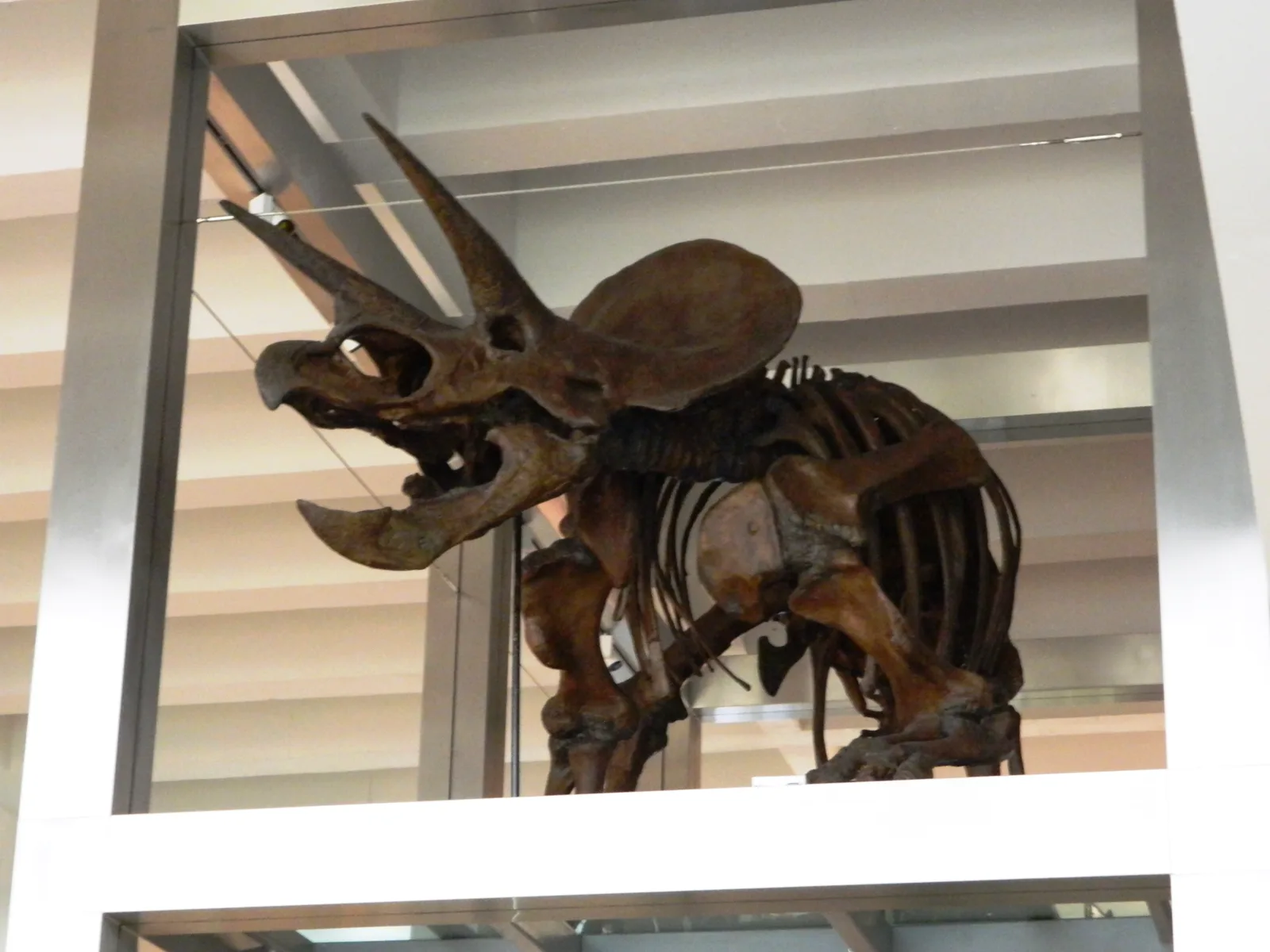
Mounted skeleton at the Ulster Museum, Belfast. The file page calls it Triceratops horridus. Bazonka, CC BY-SA 3.0, via Wikimedia Commons. ShareAlike: remixes keep the same license. The original photograph is 4320 × 3240 pixels. This page serves that full width, plus 2560 and 1600, not enlarged. The quarry is not named on the file page. File page

TODO machine-draft translation: English for review.
Triceratops is the three-horned plant-eater of the last part of the Cretaceous in western North America. The photograph is a mounted skeleton at the Ulster Museum in Belfast. The file page calls it Triceratops horridus. It does not say which quarry the bones came from, so this page does not invent one.
Timeline
- Erickson and Olson (1996) describe a Triceratops pelvis from the Late Maastrichtian Hell Creek Formation of east-central Montana. That is the end of the Cretaceous, in the same rock unit as Tyrannosaurus rex.
What we know
- The pelvis is MOR 799, at the Museum of the Rockies in Bozeman. It carries 58 definite bite marks and 22 possible ones. Punctures reach 2.5 cm across and 3.7 cm deep. A cast of one deep bite matches an adult T. rex tooth, including the cutting edge. No other meat-eater known from the Hell Creek fauna was large enough, in that paper’s judgment, to do this. Erickson and Olson, 1996
- At least 39 punctures are on the underside and the sides of the sacrum, so the pelvis was turned over before or during the biting. The first sacral vertebra is nearly bitten in half. About a sixth of the front of the left ilium was bitten away.
What we don’t know yet
- Whether the tyrannosaur killed this Triceratops or fed on an animal that was already dead. The paper describes feeding. It does not show the moment of death.
- Where the Ulster Museum mount was dug up. The file page does not say. This page does not guess a state or a quarry.
- A GPS point for that bitten pelvis. The 1996 paper says east-central Montana and prints no coordinate. The pins on this map are other Triceratops horridus localities from the Paleobiology Database, not that bone.
Its role in Earth’s ecosystem
The bite marks are a direct link in a food web. An adult Tyrannosaurus rex, or more than one, bit into this Triceratops pelvis hard enough to overturn it and to cut bone. Triceratops was not only a horned animal standing in a landscape. It was flesh in a T. rex meal, at least after death. Erickson and Olson, 1996
The paper does not count how often this happened, and it does not show Triceratops eating. The horns and the beak are visible on the Belfast mount. What plants those jaws cropped is not in the 1996 paper, so this page does not name a diet.
Sources (5)
- Erickson and Olson, 1996, Journal of Vertebrate Paleontology
- Paleobiology Database — Lance Creek collection 46130
- Paleobiology Database — Sand Arroyo collection 49016
- Paleobiology Database — Briggsdale collection 49529
- Wikimedia Commons — the hero photograph, CC BY-SA 3.0
Where the fossils are
Each icon is this dinosaur, drawn for this site. It sits on a fossil locality as that place is today.
These icons mark fossils on today’s map. When the animal lived, the continents were not in these places.