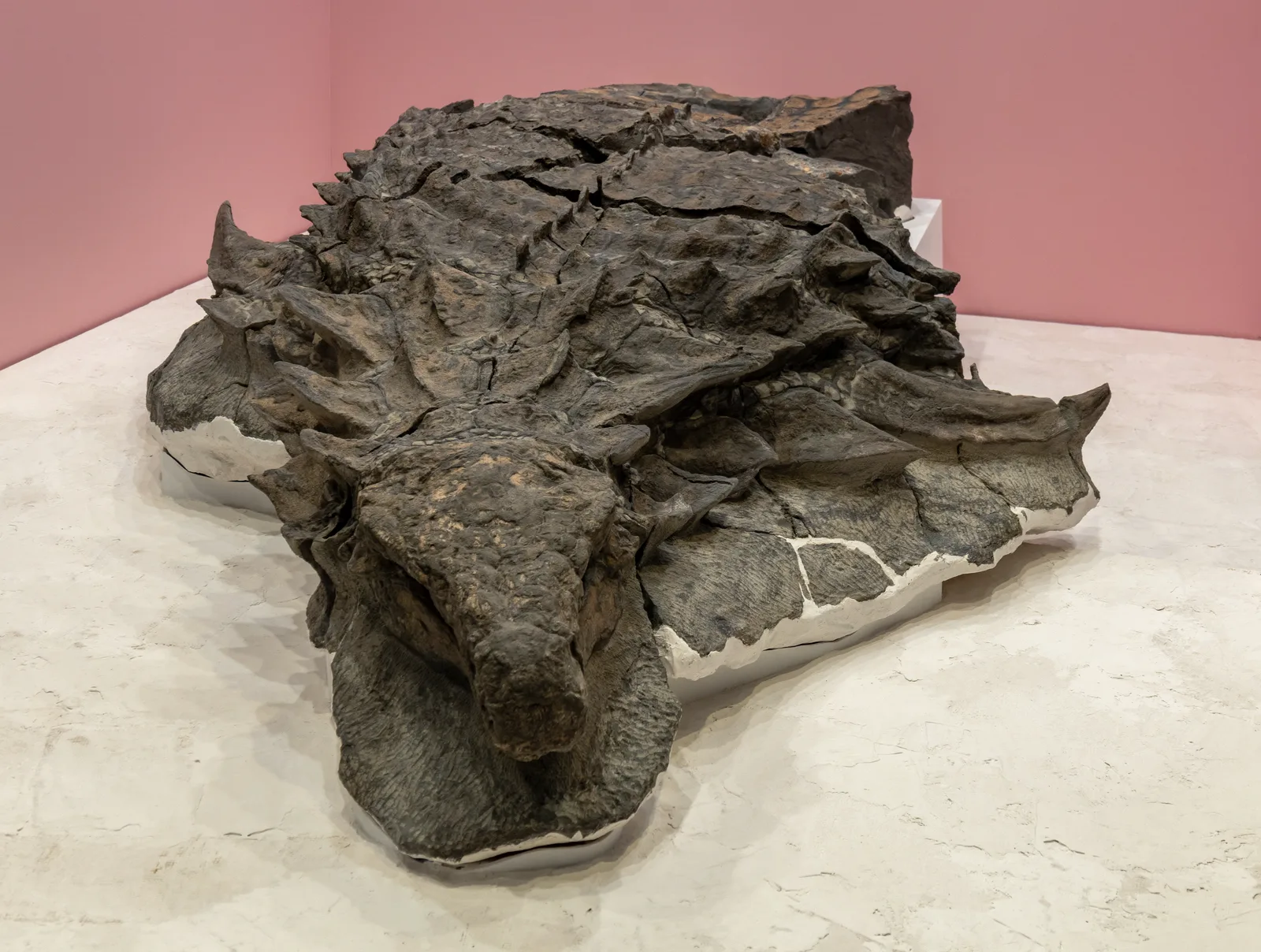
שלד אחד, עדיין בתוך העור
Borealopelta
אוכל צמחים משוריין, עם ארוחת שרכים שעדיין בתוכו.
Borealopelta markmitchelli, TMP 2011.033.0001, at the Royal Tyrrell Museum, Drumheller. Chris Woodrich, CC BY-SA 4.0, via Wikimedia Commons. ShareAlike: remixes keep the same license. The original photograph is 4679 × 3533 pixels. This page serves it at 4678, 2560, and 1600 pixels wide, not enlarged. File page

TODO machine-draft translation: English for review.
Borealopelta markmitchelli is an armored dinosaur, a nodosaur, known from one skeleton. It is not a meat-eater. The skeleton is TMP 2011.033.0001.
Timeline
- The bones come from the Wabiskaw Member of the Clearwater Formation, at the Suncor Millennium Mine near Fort McMurray, Alberta. Brown, Henderson, Vinther, and others (2017) call that member Albian in the discovery section and Aptian in the locality line. Brown and others (2020) say ammonites, pollen, and foraminifera indicate an Early Albian age. This page uses Early Albian, and keeps both wordings.
- The 2017 paper estimates a length of 5.5 m and a body mass of about 1,300 kg.
What we know
- The skeleton keeps its three-dimensional shape, with skin, scales, and horn sheaths on the armor. It is on display at the Royal Tyrrell Museum in Drumheller. Brown, Henderson, Vinther, and others, 2017
- Chemical tests found the signature of pheomelanin, a reddish-brown pigment. Melanosome shapes were not preserved. The back is darker than the belly. The paper reads that pattern as countershading. The large shoulder spine is pigmented in a way the authors tie to display, not only to armor.
- A mass in the belly meets 14 of 16 checks for real stomach contents, a cololite. About 88% of it is leaf tissue. About 85% of that leaf fraction is leptosporangiate ferns. Cycad-like leaves are about 3%. Charcoal is about 6%. Brown and others, 2020 Same paper on PMC
What we don’t know yet
- The Aptian and Albian labels in the 2017 paper do not match. The 2020 paper argues for Early Albian. The stage name is not settled by a single line.
- The charcoal may mean the animal fed in a fern patch growing after a fire. The paper says “may.” It does not prove the animal sought out burns.
- Countershading is an inference from where the dark film stops. The paper is clear that melanosome bodies were not found.
Its role in Earth’s ecosystem
This animal ate plants, and the stomach shows which ones. It chose ferns and mostly skipped other plants that were in the surrounding rock. That is a herbivore shaping a fern-rich ground layer, not a high browser stripping trees. The charcoal is the paper’s evidence that fire and the plants that follow fire were part of that meal. Brown and others, 2020
The countershading, on an animal of about 1,300 kg that already carried armor, is the 2017 paper’s evidence that big predators still mattered. Living plant-eaters above about 1,000 kg usually do not wear camouflage, because adults are rarely killed. Borealopelta breaks that living pattern. The authors read it as predation pressure strong enough to favor hiding, even with armor. The shoulder spine, differently pigmented, is their candidate for a display signal to other Borealopelta, not only a weapon.
Sources (3)
- Brown, Henderson, Vinther, and others, 2017, Current Biology. The skeleton, the pigment, and the predator-pressure argument.
- Brown and others, 2020, Royal Society Open Science. The stomach contents, the mine grid, and the Early Albian age.
- Wikimedia Commons — the hero photograph, CC BY-SA 4.0
Where the fossils are
Each icon is this dinosaur, drawn for this site. It sits on a fossil locality as that place is today.
These icons mark fossils on today’s map. When the animal lived, the continents were not in these places.